Localism and Solving the Trade Deficit

A Trade Deficit is the result of people buying goods and services from outside their communities on credit. It is a social phenomenon. It happens because local and national government is weakened and becomes the dispenser of benefits rather than the shepherd of wealth.

Imagine what could happen if somewhere like Sunderland had an innovative Local Government with real economic power. It would deal with its local economic problems by cutting Business Rates for local companies that used local goods and services, perhaps refunding a fraction of local rates on obtaining copies of local receipts. It would ask local business to produce lists of goods and services that it could not obtain locally and circulate these to local businesses and budding entrepreneurs with contact details of potential customers. It would create strong local business groups, with financial incentives to attend, perhaps merging with Chambers of Commerce. It would encourage local business consumers to discuss with suppliers how missing goods and services could be provided. It would commission local ISPs (Internet Service Providers) that would offer free Internet services locally, all Internet Services would flow through the local node and they would provide a sales platform for local business. Local Government would give new businesses a holiday from all taxation during the first two years. It would wherever possible avoid employing any companies from outside its area of governance so that its taxes were used to stimulate its economy.

The local government would be a business leader, seeing local production as the source of local revenue. It would not just be the dispenser of benefits obtained from an amorphous taxation revenue. It would engage the whole business community in the idea of local enterprise.

Turning Local Government into centres of enterprise could be achieved fairly easily. To encourage enterprise Local Government should have two elected Chambers. The Enterprise Chamber and the Benefits Chamber. The Enterprise Chamber would provide funds for the Benefits Chamber to spend. This division of responsibilities is essential because those who enter public service to provide benefits are not usually backers of enterprise.

How did production become detached from locality? Over the past two centuries large businesses realised that local control was damaging its potential profits and so removed local customs tariffs and other impediments to trade. There can be no doubt that some trade liberalisation was a good thing but the modern mantra that local people should be entirely excluded from the control of trade is absurd. Large business is continuing this destruction of local control globally. It calls this “globalization” but globalisation is actually a result of Western Culture spreading globally and the concomitant growth of Multinational Corporations is just a side effect of it. (See Globalisation, Global Trade and Internationalism – Who Benefits? ).

Multinational Corporations are the opposite of Localism. They appeared in force in the seventeenth century with the various “East India Companies” and spearheaded the growth of European Empires and war. They allowed individual nations to use far more resources than they could obtain from their own land and so began the path to unsustainable economic models for global growth. There is a role for multinationals but they should not be so favoured that we remove local, sustainable, governance by Nations and Local Government.

undefined

The world is on a knife edge that cuts in many different ways: some believe that there is a threat of nuclear war, others that global warming will destroy us, some that AIs will decimate economies, yet others that cheap genetic manipulation will allow viral terrorism etc etc. In response many people dream of global government, presumably largely run by enlightened Chinese people, curiously this solution – Chinese Capitalism, Capitalism without democracy – is also the preferred solution of multinational bosses who believe that CEOs of Multinationals know what is best for us all. Adults realise that the only sensible solution is for the people in each viable economy to govern themselves and to respect other peoples’ independence.
The UK Current Account

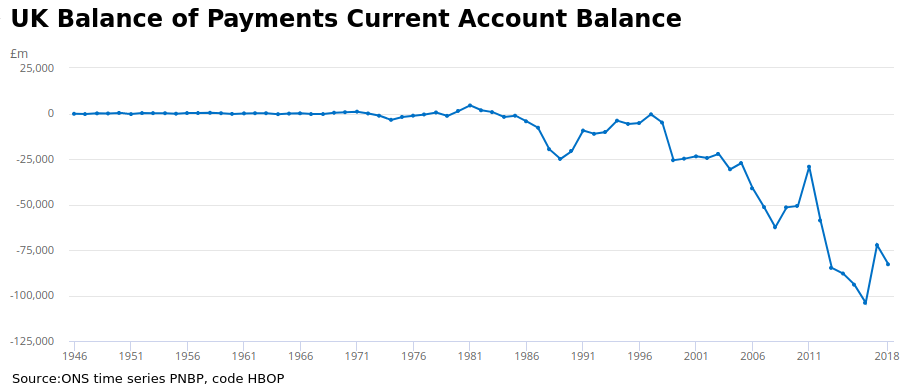
The UK Current Account of the Balance of Payments is in near catastrophic deficit. It is obvious that a country cannot operate a huge current account deficit indefinitely because it will run out of money. It can run the deficit while it is credit worthy but the deficit itself destroys that credit worthiness. As Sushil Wadhwani, then a member of the Bank of England Monetary Policy Committee said, current account deficits “appear not to matter until, well, they suddenly do.” As any profligate businesses know, life is a party until the bank suddenly calls in its loans.

“… a reduction in the current account deficit from its current record [peacetime] levels will be important for any government wishing to claim that the UK is making a balanced and sustainable economic recovery.” See  Parliamentary Report

undefined

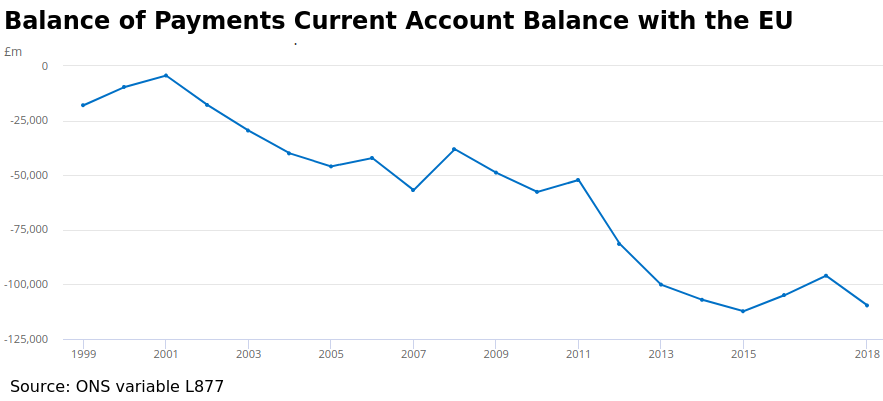
According to the Parliamentary Report above, “The risks from the current account deficit will become greater the longer that it remains at its current high level.” The Current Account Deficit of £83bn is almost entirely due to the EU.

undefined

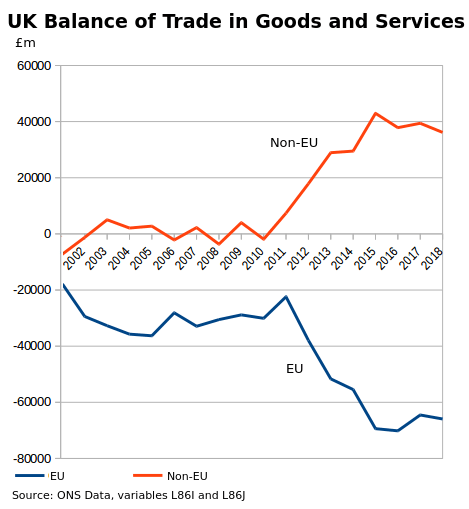
In 2018 the UK-EU Current Account Deficit was about £110bn. (The Current Account is in surplus with the Non-EU rest of the world by about £27bn).

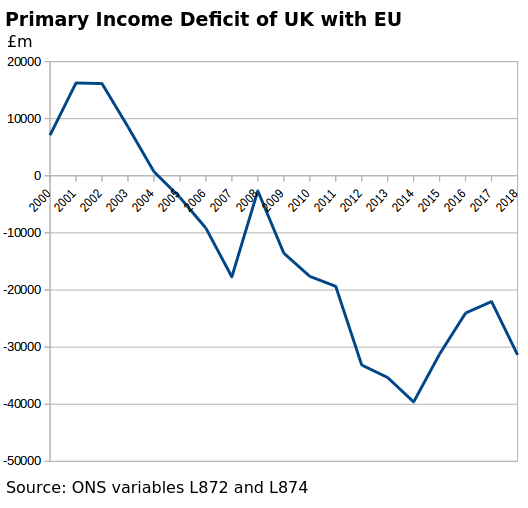
The deficit with the EU is composed of the UK-EU Trade Deficit of £66bn plus the UK’s EU Net Contributions of £9bn plus about £35bn of profits, dividends, rents etc paid to EU Corporations, businesses and individuals (the Primary Income Deficit).

undefined

The Primary Income Deficit with the EU is serious. The UK has financed much of its Trade Deficit with the EU by selling businesses and property to EU investors, this seems, superficially, to be a neat way of avoiding debt. Unfortunately these asset sales have created a long term liability for the payment of rents, profits etc. overseas. The scale of these payments now rivals the UK-EU Trade Deficit. The Trade negotiations should find innovative ways of hindering the return of profits, rents etc to the EU.

The Current Account Deficit is both caused by, and causes, the Government Budget Deficit, the two go hand in hand because of the Sectoral Balances Equation. Until the Current Account Deficit is fixed there will be Austerity and until Austerity helps fix the Current Account Deficit there will be a Budget Deficit. Unfortunately in the case of the UK the Primary Income Deficit and Trade Deficit need more sophisticated measures than simple Austerity. Our Trade Negotiators should make a start by ensuring that they do not build a Trade Deficit into our economy.

The UK-EU Trade Deal

The forthcoming EU Trade Deal will set the tone of all further UK Trade Deals.

There are two objectives for Trade Deals: increase the volume of trade and keep the Trading and Current Accounts in balance in the long term.

The second objective, that of balancing the accounts in the long term, is usually admitted to be important by economists because it is obvious that perpetual deficits will eventually bankrupt an economy. However those same economists will often attempt to draw the attention of their audience to the medium or short term, averring that a bit of debt is fine etc. Our audience, the Trade Negotiators, should be reminded that for the UK the Trade and Current Account deficits have been substantial since the early 1990s when the UK attempted to join the ERM and have been getting progressively worse.

Persistent Current Account and Trade Deficits do not just create debt. They present governments with options such as either increasing indebtedness or expediting the sale to overseas investors of assets such as businesses and property. When confronted with asset sales or increasing debt most governments choose to sell assets to overseas investors. This creates long term liabilities that are even more serious than shorter term debts because profits, earnings, dividends and rentals are paid overseas, further worsening the Current Account.

Allowing the Current Account deficit to get hopelessly out of control is the hallmark of poor government. Greece, Portugal and Spain are still floundering in a pit of high unemployment and austerity because they listened to the fashionable economists of the early noughties who assured them that Current Account Deficits were harmless. Economic reality is not harmless.

undefined

As a rule of thumb a Current Account Deficit that exceeds 5% of GDP for a decade or more will lead to disaster. Governments that take this path are criminally negligent. The UK Current Account has just entered the danger zone and it is the responsibility of Trade Negotiators to do nothing that would pitch the country into a Balance of Payments crisis simply because they believe the mantra of the noughties that Trade and Current Account Deficits do not matter. These deficits do matter, large, persistent deficits must be avoided.

Certainly trade negotiations should increase imports but they must also increase real exports to maintain a balance.

Create your own website, free on WordPress.com.Create your own website.
Start free