The UK Current Account of the Balance of Payments is in near catastrophic deficit. It is obvious that a country cannot operate a huge current account deficit indefinitely because it will run out of money. It can run the deficit while it is credit worthy but the deficit itself destroys that credit worthiness. As Sushil Wadhwani, then a member of the Bank of England Monetary Policy Committee said, current account deficits “appear not to matter until, well, they suddenly do.” As any profligate businesses know, life is a party until the bank suddenly calls in its loans.
“… a reduction in the current account deficit from its current record [peacetime] levels will be important for any government wishing to claim that the UK is making a balanced and sustainable economic recovery.” See Parliamentary Report
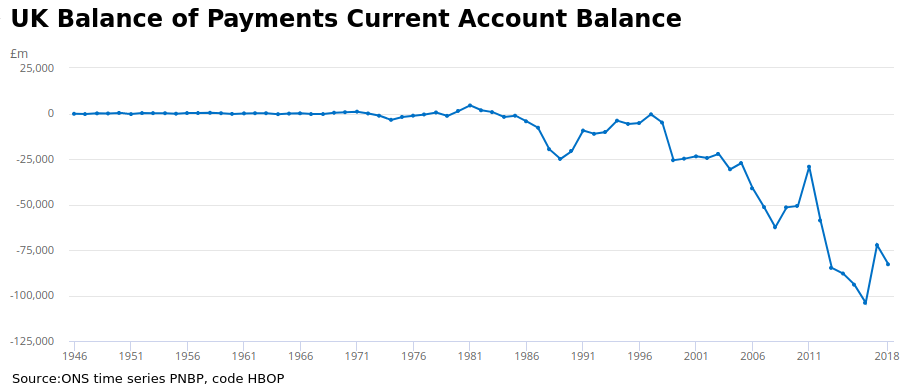
According to the Parliamentary Report above, “The risks from the current account deficit will become greater the longer that it remains at its current high level.” The Current Account Deficit of £83bn is almost entirely due to the EU.
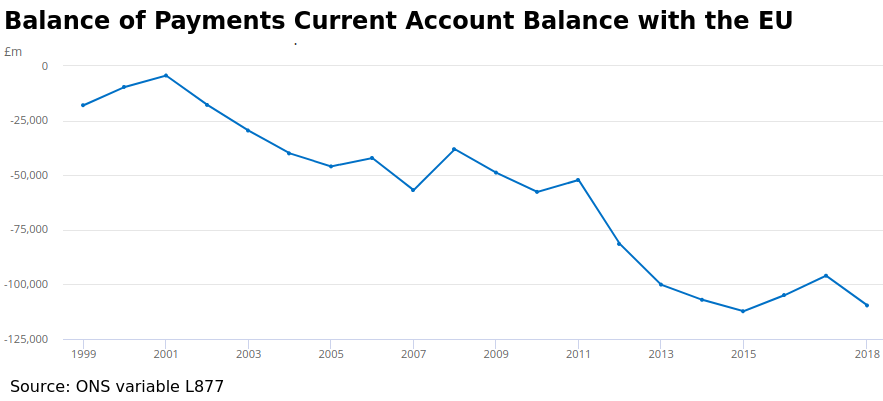
In 2018 the UK-EU Current Account Deficit was about £110bn. (The Current Account is in surplus with the Non-EU rest of the world by about £27bn).
The deficit with the EU is composed of the UK-EU Trade Deficit of £66bn plus the UK’s EU Net Contributions of £9bn plus about £35bn of profits, dividends, rents etc paid to EU Corporations, businesses and individuals (the Primary Income Deficit).
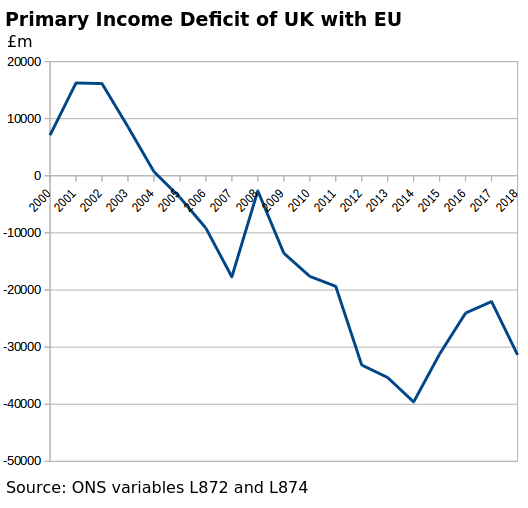
The Primary Income Deficit with the EU is serious. The UK has financed much of its Trade Deficit with the EU by selling businesses and property to EU investors, this seems, superficially, to be a neat way of avoiding debt. Unfortunately these asset sales have created a long term liability for the payment of rents, profits etc. overseas. The scale of these payments now rivals the UK-EU Trade Deficit. The Trade negotiations should find innovative ways of hindering the return of profits, rents etc to the EU.
The Current Account Deficit is both caused by, and causes, the Government Budget Deficit, the two go hand in hand because of the Sectoral Balances Equation. Until the Current Account Deficit is fixed there will be Austerity and until Austerity helps fix the Current Account Deficit there will be a Budget Deficit. Unfortunately in the case of the UK the Primary Income Deficit and Trade Deficit need more sophisticated measures than simple Austerity. Our Trade Negotiators should make a start by ensuring that they do not build a Trade Deficit into our economy.

